ShiXinFeng wrote:...who are the true protagonists?
This is where the structure falls apart, and, to me, why the game fails in a story sense.
The game doesn't easily define a protagonist, though you wouldn't know it by the radical changes put in recent chapters that shift Machine and Zion morality lines into simplistic safe zones. You're supposed to make up your own mind over who is the "most good" good guy and go with that, or at least recognize the perks of joining with an evil corporation, like the Merovingian. This is what the earlier chapters established, with the Machine struggling to prove they aren't the heartless bastards that Zion thought they were. If you'll take a closer look now, you'll notice that was shredded with the breaking of the Truce, the seemingly arbitrary "Okay, we're done having fun, time to die, puny humans" way the Machs broke it off, and their sharply increased animosity with their human operatives.
EPN and Zion might as well be merged. I don't care how vigorously someone might defend the differences in motivations. They are essentially the same organization, now that they have both been slated as enemies by the Machines. Unless EPN finds a way to distance itself from Zion more effectively (more radical approaches to the founding goal of pursuing Neo/Morpheus's legacies), they might as well shack up. Not surprisingly, the same goes for the Cypherites. Veil may be the Matrix version of Xenia Onatopp (probably more than a coincidence considering the thick Russian and Cold War references back when MxO was "good"), but Cryptos keeps her right in line with his literally being half a Machine.
The Merovingian has always been portrayed as a bad guy. In my viewpoint, a truer, simpler way to preserve the "good guy, bad guy" trinity of the game would have been to quickly establish the Merovingian as the big bad boss man, and to have the main conflict between the Machines and Zion be how to handle his criminal manifestations, which would have led to a somewhat stable cycle of Win Some/Lose Some scenarios on all three sides. I believe this is what was initially experimented with when the Merovingian was revealed to be the source behind the Assassin, although the General understandably complicated things.
The plain, sad truth is that the world of the Matrix Online was poorly prepared for actual war, which has been proven by the oh-so-coincidental appearance and distraction of the Intruder. Call me a skeptic, but if the Intruder never popped up, the war thing probably would have gotten really really old rather rapidly. After all, it's clear that the Machines could quickly win a war if they pooled all their resources and tactical abilities. And then there's the question of why we're even fighting.
But that's not really a story question, now, is it?Sorry, I went off topic and ranted a bit, but I needed to get that off my chest. Again, it's 1999 because
that's what Rarebit says it is. You'll find it impossible to prove otherwise until and unless he says otherwise. That's just the way things are.
Edit: I want to add something and incorporate PS10N's post above mine into my own little rant, since I both agree with it and enjoy his philosophical observations, in that in a good political-alliances game, the system would set up to look a bit like a "Y", with the Merovingian at one end and the Machines and Zion at the other, but with their own conflicted ideals, so, really, it would look like a "Y" with the two branches connected by another line. I don't know if that would be an ideal approach, but it looks stable enough to me on paper, and maybe even in practice if you study the older chapters of MxO.


 "The End is Near, the Time is Now." | W4rbl4de | Reviled Restoration-CYPHERITES

 )
)
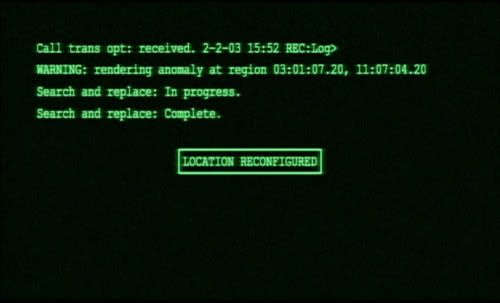
 then he finds the "One" in 1999 and when the Matrix used to be reset because the previous ones Chose to save humanity instead of Trinity the data also got reset to 1989 again, Because Neo didn't reset the Matrix in the latest iteration I think that the timeline has just continued as normal upto 2003, so really this 1999 thing is rubbish IMO.


 What about in the earlier versions of the Matrix, would they have locked the time in there too?